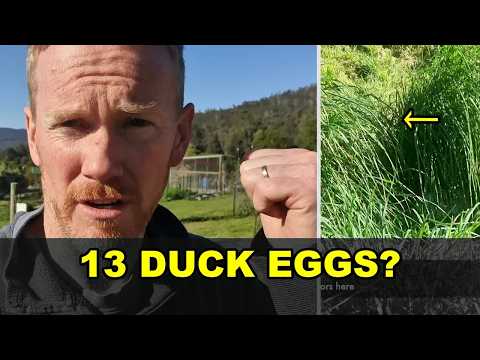
A spring morning on our small Tasmanian homestead ends with an exciting discovery: one of our ducks is tucked away in the long grass, sitting on around 13 eggs.
Before checking the nest, Charles works through the ordinary morning rounds: feeding the ducks, moving the Australorps onto fresh ground, visiting the Hy-Lines and guinea pigs, collecting eggs and turning on the garden irrigation.
What happens in this episode
- Feeding the ducks on a bright spring morning.
- Moving the Australorps and their portable fencing onto fresh ground.
- Checking feed, water and the rest of the morning animal jobs.
- Visiting the Hy-Lines and guinea pigs.
- Collecting the morning eggs.
- Turning on the garden irrigation after several dry days.
- Checking the hidden duck nest in the long grass.
Our morning-rounds checklist
These rounds are less about following a perfect routine and more about noticing what has changed overnight. We check that every animal is accounted for, feed and water are available, fencing is secure, eggs are collected and the garden has what it needs for the day.
- Count the animals and check their general behaviour.
- Top up feed and confirm clean water is available.
- Inspect portable fencing before moving or releasing the birds.
- Collect eggs and look for signs that a hen or duck is nesting elsewhere.
- Check whether the garden needs irrigation.
A duck nest hidden in the grass
The surprise at the end of the morning was finding our duck still settled deep in the grass on roughly 13 eggs. If all goes well, we may have ducklings to share in the next week or two. We will keep watching from a respectful distance and let her do the work.
Watch on YouTube: A Hidden Duck Nest with 13 Eggs? | Growing Our Way #19.
Follow more practical stories from our Tasmanian homestead by subscribing to Growing Our Way on YouTube.